
Table of Contents
- How to Rig Dodgers for Kokanee: The Complete Setup
- What You'll Need Before You Rig a Dodger
- Step-by-Step: How to Rig Dodgers for Kokanee
- Kokanee Dodger Leader Length: Starting Points and Adjustments
- Kokanee Dodger Size: Matching the Dodger to Your Lure
- Best Dodger Color for Kokanee: Light and Water Conditions
- Kokanee Trolling Speed: Dialing In the Right Action
- Common Rigging Mistakes and How to Fix Them
- Frequently Asked Questions
Last Updated: October 9, 2026
How to Rig Dodgers for Kokanee: The Complete Setup
Kokanee fishing rewards small details. Get the dodger rig right and you turn a follow into a strike.
A dodger is a flat, flashtype attractor that swings side to side in the water. It does not spin.
Below, we break down the tackle you need, the exact rigging sequence, and how to tune leader length, dodger size, color, and speed.
What You'll Need Before You Rig a Dodger
Gather your tackle before you start tying so you are not fumbling on a rocking boat.
- Main line: 12-pound test monofilament is a solid all-around choice for kokanee trolling.
- Dodger: sized to your target depth and lure.
- Leader line: lighter than your main line, often 8 to 12-pound test.
Keep leader material and spare swivels in a small box on deck, you will re-tie more than you expect.
Step-by-Step: How to Rig Dodgers for Kokanee
Here is the full rigging sequence, with the specific hardware and knots that make it reproducible. Follow the steps in order and you will have a clean, tangle-free rig you can rebuild the same way every time.
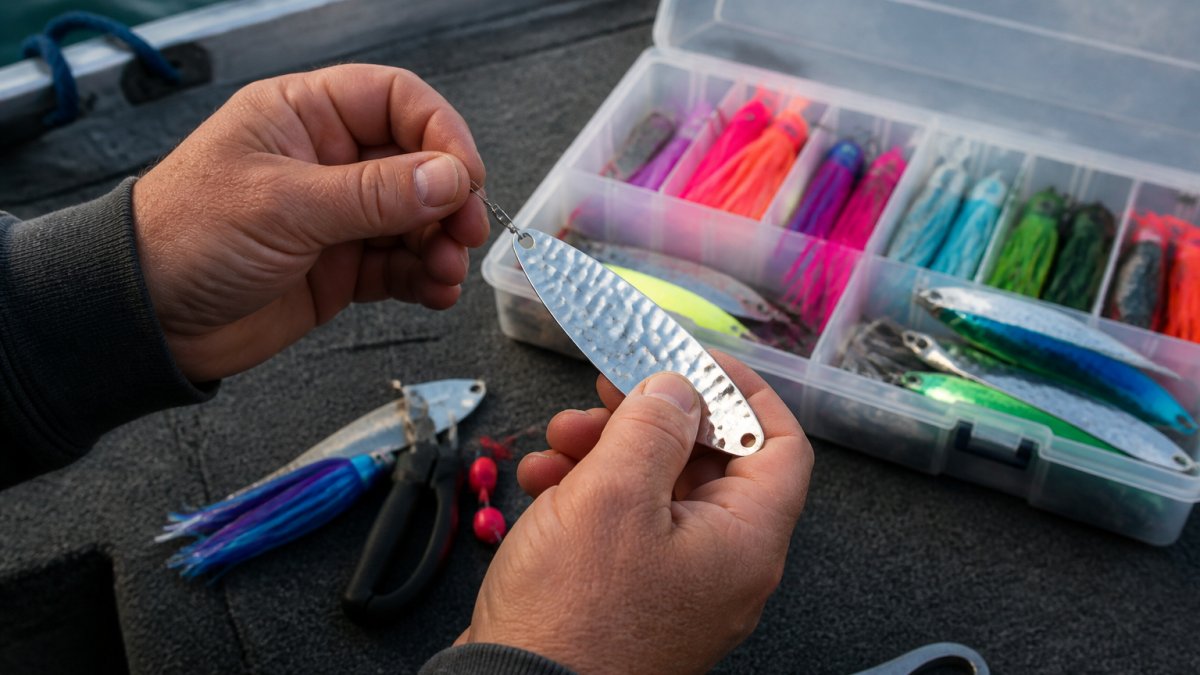
Step 1: Attach Your Main Line to the Dodger
Tie your main line to the front eye of the dodger, the attachment point that faces your rod; the rear eye faces your lure.
Add a ball-bearing swivel between the main line and the dodger to stop line twist. A size 10 to size 12 ball-bearing swivel matches 8 to 12-pound main line without adding bulk. A snap swivel lets you swap dodgers in seconds, but a plain ball-bearing swivel plus a split ring keeps the dodger swinging more freely.
Step 2: Tie the Leader to the Back Eye
Cut a leader to your starting length (see the leader-length section below). Tie one end to the rear eye of the dodger with the same knot you used on the front. This leader is your adjustable zone: shorten it to tighten the action, lengthen it to soften it.
Monofilament in 8 to 12-pound test is the common choice: it stretches to absorb a kokanee's soft-mouth strike and floats slightly, keeping the lure tracking behind the dodger. Fluorocarbon in the same test is less visible in clear water but stiffer and sinks, which can pull the lure out of the dodger's flash zone.
Step 3: Add Your Lure or Squid Behind the Dodger
Tie your lure or squid to the free end of the leader. Add a 3mm to 4mm plastic bead above the knot to protect it and add a flash point without adding weight.
If your lure has a split ring, use it rather than tying directly to the hook eye, it lets the lure swing freely and reduces leader wrap.
Step 4: Check the Whole Rig Before It Hits the Water
Hold the dodger by the front swivel and let the leader and lure hang. The lure should hang straight and the leader should not be twisted. Run your fingers down the leader for nicks or rough spots, a frayed leader is the most common cause of a lost fish. Check that the swivel turns freely and the split ring is fully closed.
A Reproducible Tackle List
To rebuild this rig exactly:
- Main line: 12-pound test monofilament
- Front connection: size 10 to 12 ball-bearing swivel
- Dodger: sized to your target depth and lure (see the size section)
Kokanee Dodger Leader Length: Starting Points and Adjustments
The right kokanee dodger leader length depends on your dodger type and lure. Start at 8 to 12 inches from the back of the dodger to the lure.
Use these starting points, then adjust:
| Dodger Type | Lure Behind It | Starting Leader Length |
|---|---|---|
| Small dodger | Small squid | 8 to 10 inches |
| Small dodger | Spinner | 10 to 12 inches |
| Larger dodger | Squid | 12 to 16 inches |
| Larger dodger | Spoon or spinner | 14 to 18 inches |
If fish follow but do not strike, shorten the leader by an inch or two. If the lure looks dead, lengthen it slightly. Make one change at a time so you know what worked.
Kokanee Dodger Size: Matching the Dodger to Your Lure
Kokanee dodger size should match your lure and trolling depth. Too big overpowers a small lure and spooks fish; too small will not throw enough flash to pull fish in from a distance.
Dakota Dodger - Silver Fish Scale - Brass Series →
Match the dodger to the lure, not the other way around:
- Small lures and squids: pair with a small dodger for a tight, quick action.
- Larger squids and spoons: step up to a larger dodger so the flash matches the profile.
- Deep trolling: a slightly larger dodger reads better in low light at depth.
Our Dakota Dodger in Silver Fish Scale is a good match for small squids and spinners when you want a clean silver flash. For a bigger profile, the 5.5" Dodger in Pink & Cracked Ice pairs well with larger squids.


Best Dodger Color for Kokanee: Light and Water Conditions
The best dodger color for kokanee changes with light and water conditions. Bright, clear days call for silver and natural finishes. Low light, stained water, and early or late hours call for brighter colors that stand out.
Use color to match the conditions:
- Bright sun, clear water: silver, chrome, and natural scale patterns.
- Overcast or low light: pink, orange, and chartreuse for visibility.
- Stained or green water: bright pinks and purples that pop against the tint.
Kokanee respond to flash and contrast more than any single color. A dodger that flashes well in the current light out-fishes a "perfect" color that disappears in the conditions you are fishing.
Kokanee Trolling Speed: Dialing In the Right Action
Kokanee trolling speed controls your dodger's action, and the right speed depends on dodger size, leader length, and depth. Most kokanee anglers troll slowly, a common starting window is 1.0 to 1.5 mph, but that window shifts with the dodger. A small dodger kicks at the low end; a larger one needs more speed to swing.
How Speed Changes Dodger Action
A dodger works by swinging side to side, not spinning, and speed drives that swing:
- Too fast: the dodger spins instead of swinging, the leader twists, and the lure tangles. You will see the dodger roll or helicopter in the water.
- Just right: the dodger swings side to side with a steady rhythm and the lure tracks straight behind it.
- Too slow: the dodger stops flashing and the lure loses action. The rig goes dead in the water.
A Tuning Procedure You Can Run on the Water
- Start at 1.2 mph and watch the dodger for 30 to 60 seconds. If you cannot see it, watch the rod tip for a steady rhythmic pulse.
- Speed up in 0.1 mph steps until the dodger swings with a clear side-to-side rhythm. Note the speed.
- Speed up one more step. If the dodger spins or the leader twists, back off to the previous speed, that is your working speed for this dodger and leader.
- Change one variable at a time. If you shorten the leader, re-check the speed; a shorter leader tightens the action and may need a slower troll to avoid spinning.
Speed by Depth and Condition
- Shallow, clear water: troll at the low end of the window (around 1.0 to 1.2 mph) so the dodger stays subtle.
- Deep water or low light: a slightly faster troll (1.3 to 1.5 mph) keeps the dodger flashing where light is weak.
- Cold water, sluggish fish: slow down. Kokanee in cold water are less willing to chase a fast presentation.
Speed and Downrigger Release
If you fish a downrigger, speed affects the release. Too fast and the line pops off without a fish; too slow and the release drags. Set the tension so the line holds at your working speed but releases cleanly on a strike, and check the release after every fish, a stretched band will not hold the same tension.
Common Rigging Mistakes and How to Fix Them
Most dodger rig problems come down to a handful of fixable mistakes:
- Leader too long: the lure drifts away from the flash. Fix it by shortening the leader.
- No swivel at the front: line twist builds and tangles the rig. Add a ball-bearing swivel.
- Lure spinning on its own: the leader tangles. Check the lure and slow your troll speed.
Fix one thing at a time, the leader, then the speed, then the color. Change everything at once and you never learn what the fish wanted.
For a proven starting lure behind your dodger, our Kokanee Khaos in Pink & Blue and Kokanee Khaos in Purple & Pink are built to run straight and flash behind a dodger.

For more on trolling setups and how dodgers fit into a full spread, Take Me Fishing's guide to trolling for kokanee covers the basics of boat speed and depth control.
A dodger rig is only as good as its weakest connection. Check your knots, your swivels, and your leader after every fish.
Frequently Asked Questions
What is the best dodger color for kokanee?
Color choice depends on light and water conditions. In clear water with bright sun, silver, brass, and natural fish-scale patterns work well because they flash without looking unnatural. In stained water or low-light periods, pink, purple, and blue dodgers stay visible longer. The Reel Therapy Tackle 5.5-inch Dodger in Pink & Cracked Ice ($8.95) is a solid all-around pick for kokanee, and the Dakota Dodger in Silver Fish Scale ($7.95) covers clear-water days.
How long should the leader be behind a kokanee dodger?
A common starting point is 8 to 12 inches for a dodger with a squid or hoochie, and 12 to 18 inches when running a spinner or small spoon. If fish are following but not committing, shorten the leader by 2 inches at a time. If the lure looks lifeless, lengthen it. The goal is to find the length that gives the lure a lively, darting action behind the dodger's swing.
What size dodger should I use for kokanee?
Most kokanee setups use dodgers between 4 and 6 inches. A 4-inch dodger is a good match for small squids and light leaders, while a 5.5-inch dodger like the Reel Therapy Tackle 5.5-inch Pink & Cracked Ice ($8.95) pairs well with spinners and larger hoochies. Match dodger size to lure size: a big dodger with a tiny lure can overpower the action and spook fish.
How fast should you troll a dodger for kokanee?
Kokanee trolling speed with dodgers usually falls between 1.0 and 2.0 mph. Start at 1.2 to 1.5 mph and watch your rod tip for a steady throb. If the dodger is spinning instead of swinging side to side, slow down. If it feels dead, speed up slightly. Adjust in 0.2 mph increments until you find the speed that keeps the dodger flashing and the lure darting.
Kokanee fishing is a game of small adjustments, and the dodger rig is where most of them happen. Reel Therapy Tackle builds dodgers, squids, and bundles made by anglers and proven on the water, so you can spend less time guessing and more time dialing in your setup. Our gear ships at low cost, with free delivery on orders over $50. Browse the collection, add to cart, and rig up with tackle built for the strike.